In press. This study develops a statistical sampling framework for estimating onion seedling density in data-scarce smallholder farming systems in Pwalugu, Upper East Region of Ghana. Using field observations from a two-acre farm and applying the Central Limit Theorem, the work estimates mean planting density and quantifies variability in manual transplanting practices. The results provide a practical planning model for estimating seedling requirements based on effective bed area, offering a low-cost decision-support tool for traditional agricultural systems.
Co-authored publication (2024). This work is a peer-reviewed research article published in an academic journal indexed in NASA ADS. My contribution forms part of a collaborative research effort spanning data analysis and computational modeling within the study domain.
2KAP is a mobile-first group contribution wallet platform built for communities, churches, committees, and individuals who need a simple, trusted way to collect and manage contributions. The platform supports mobile money payments via USSD and QR, offers transparent contribution tracking, and gives contributors control over their privacy through public or access-code-protected wallets — eliminating the need for spreadsheets or manual tracking.
A professional business website designed and developed for Renoval Solutions. Built as a static site and hosted on GitHub Pages, showcasing the company's services, portfolio, and contact information.
Platform site for Yenko WiFi, an internet service provider project. Designed to communicate service offerings, coverage, and subscription details to prospective customers.
A newly developed business platform for Tim Supply. Designed to present the company's products and services with a clean, professional web presence.
A clean, professional personal portfolio and CV site built for Timothy Azirigo, a logistics and transport management professional based in Accra, Ghana. The site presents his career profile, work history spanning operations management, logistics, and procurement, educational background including an MBA from GIMPA, professional certificates, and a downloadable CV — serving as a complete digital resume and personal brand presence.
The package implements two iterative techniques called
T3Clus and 3Fkmeans, aimed at simultaneously clustering
objects and a factorial dimensionality reduction of
variables and occasions on three-mode datasets developed
by
\(\href{https://doi.org/10.1007/s00357-007-0006-x}{\text{Vichi
et. al}}\) in 2007. Also, we provide a convex
combination of these two simultaneous procedures called
CT3Clus and based on a hyperparameter \(\alpha\)
(\(\alpha \in [0,1]\), with 3FKMeans for \(\alpha=0\)
and T3Clus for \(\alpha=1\)) was also developed in
\(\href{https://doi.org/10.1007/s00357-007-0006-x}{\text{Vichi
et. al}}\). Furthermore, we implemented the traditional
tandem procedures of T3Clus (TWCFTA) and 3FKMeans
(TWFCTA) for sequential clustering-factorial
decomposition (TWCFTA), and vice-versa (TWFCTA) proposed
by
\(\href{https://doi.org/10.1007/978-3-642-79999-0_1}{\text{P.
Arabie and L. Hubert}}\) in 1996.
| source codes | publication |
|---|---|
| Python (Github) | PyPI |
| R (Github) | R-CRAN |
As the creator of The Addon Forge, I design and develop high‑performance browser extensions focused on web automation, productivity enhancement, and media extraction. The brand emphasizes clean engineering, user‑centered design, and seamless cross‑browser compatibility.
My published extensions enable efficient downloading of product videos and media assets from major e‑commerce platforms such as Alibaba and AliExpress, with upcoming releases expanding into YouTube media extraction and additional workflow optimization tools. All extensions are actively maintained, performance‑optimized, and built using modern JavaScript and WebExtension APIs.
| Source Codes | Publication |
|---|---|
| Alibaba Media Downloader |
Chrome Web Store Firefox Add‑ons |
| AliExpress Media Downloader |
Chrome Web Store Firefox Add‑ons |
| The Addon Forge YouTube Channel | Tutorials, Demonstrations, Release Notes |
| YouTube Music Video Downloader | Upcoming Release |
In this study, we conducted a case study on improving the
National Health Insurance Scheme (NHIS) coverage in the
Sunyani municipality. We used the Contingent Valuation
Method (CVM), a technique for estimating the Willingness To
Pay (WTP) for non-market goods, to determine individuals'
willingness to pay for an extension of NHIS coverage. We
also employed Binary Logit Regression analysis to identify
factors that influence individuals' decisions to pay for an
improved NHIS, and included a social interaction term in the
model to measure the impact of other individuals' views on
an individual's decision. Our research results showed that a
majority of NHIS holders who purchase additional drugs when
visiting a health facility were willing to pay for an
extension of NHIS coverage. The most costly medical
conditions for which respondents usually purchased
additional drugs and were willing to pay an additional
premium for inclusion in NHIS coverage were rehabilitation
conditions (such as vision, hearing, and dental issues),
cancer, and heart-related surgeries. On average, respondents
were willing to pay no more than GH₵30.00 per year to cover
these conditions. We recommended that policymakers or
planners consider income, gender, and level of education
when making NHIS coverage improvement decisions, as these
variables were found to be the most significant in our
model.
In this work, we developed and implemented five models,
TWCFTA, TWFCTA, T3Clus, 3FKMeans, and CT3Clus, in the
simuclustfactor packages in Python and R for the analysis of
three-mode datasets. These models were proposed by
\(\href{https://doi.org/10.1007/s00357-007-0006-x}{\text{Vichi
et al.}}\) in 2007 as an alternative to traditional tandem
models for simultaneously clustering objects and reducing
the dimensionality of variables and occasions in three-mode
datasets. T3Clus and 3Fkmeans are iterative techniques that
apply the Tucker2 algorithm and K-means algorithm
sequentially, while CT3Clus is a convex combination of these
two methods with a hyperparameter alpha \((0 \leq \alpha
\leq 1)\) that allows for the interpolation between the two.
In contrast, tandem analysis only involves the sequential
application of clustering and factorial methodologies. We
tested these simultaneous models on synthetic and real
datasets and found that they produced more well-separated
clusters with higher cohesion within clusters, and were
better at recovering object-cluster,
variable/occasion-factor associations compared to the tandem
models. The best results in terms of well-separated clusters
with high cohesion within the clusters were obtained when
the factorial analysis was prioritized, minimizing the
within-cluster deviation of the component scores (i.e. WSS
in the reduced space).
University of Aveiro
(Aveiro, Portugal)
MSc. Mathematics & Applications
August 2021 - Sept. 2022
core courses :
supervisor:
University of L'Aquila
(L'Aquila, Italy)
MSc. Mathematical Engineering
July 2020 - July 2021
core courses :
supervisor:
University of Energy and Natural Resources
(Sunyani, Ghana)
BSc. Actuarial Science
August 2019 - September 2020
core courses:
supervisor:
Achimota Senior High
(Accra, Ghana)
General Science
August 2011 - September 2014
core courses:
Project Manager
(Begoro, Ghana)
Commercial Farm Development
2025 – Present
core activities:
Technical Project Lead
(Ghana)
AgricScope Initiative
2024 – Present
core activities:
BNP Paribas – Marketing Data Analytics Hub
(Porto, Portugal)
Python Developer / Internal Tools Engineer
March 2023 – March 2025
core activities:
Xtratek Automation
(Douala, Cameroon)
Data Scientist
2020 – 2022
core activities:
Python Software Foundation (PSF)
(Sunyani, Ghana)
Team Lead
June 2019 - 2021
core activities:
University of Energy & Natural Resources
(Sunyani, Ghana)
Teaching Assistant
September 2019 - September 2020
core activities:
New Fountain International School
(Tema, Ghana)
Pupils Tutor
2014 - 2015
core activities:
IFCS 2022
(University of Porto, Portugal)
17th Conference of the International Federation of Classification Societies
July 2022
Contributed session
Machine Learning in Science
(University of Lisbon, Portugal)
Workshop of Machine Learning in Science
June 2022
participant

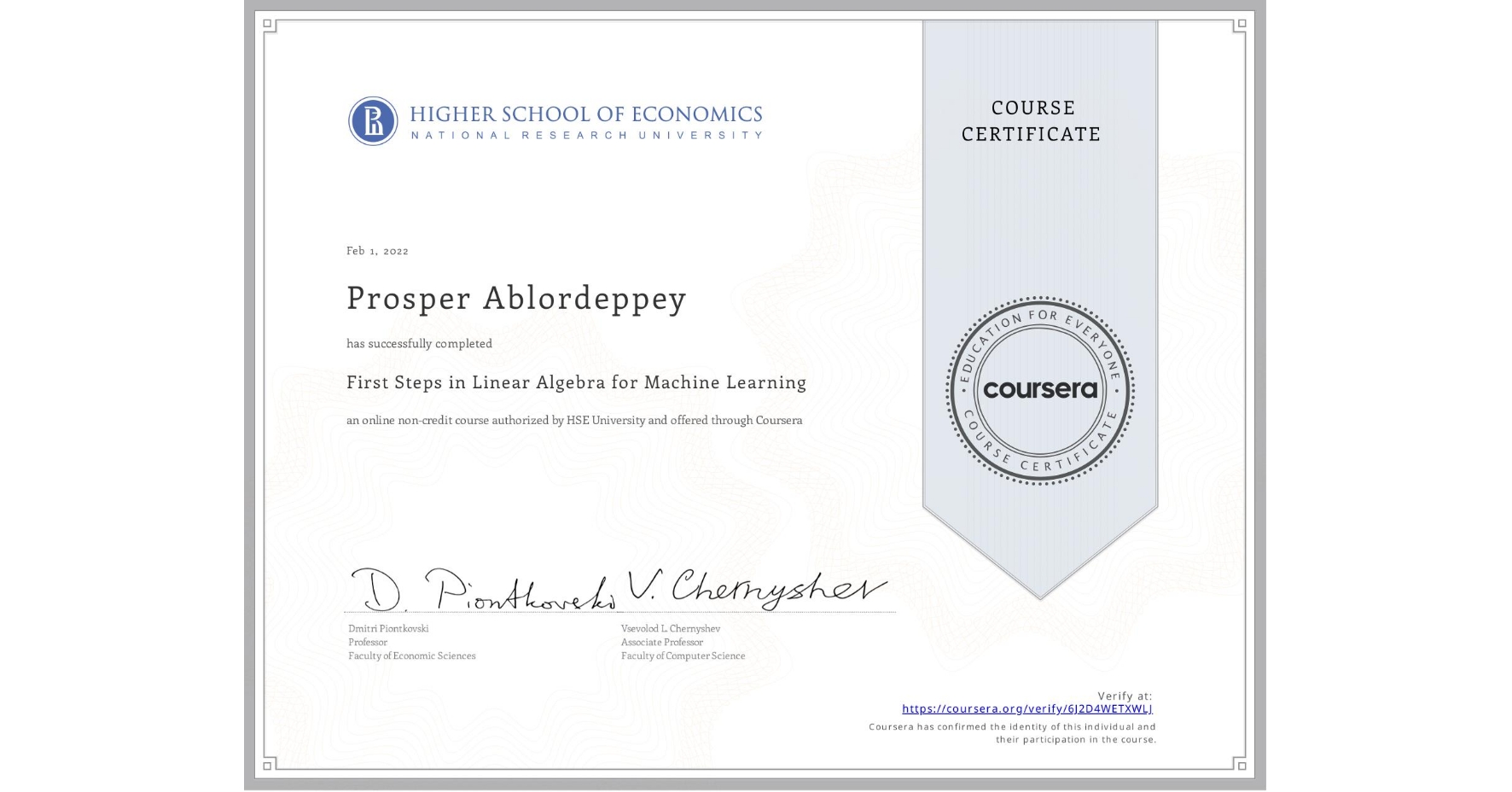
core topics:
core topics:
core topics:

core topics:
core topics:
case study of AI in:

Outline:
Outline:
